Sputtering vs. Evaporation: Which Method Is Right
You need to deposit a thin film. Two proven methods exist: sputtering and evaporation. Both work. Both have tradeoffs. A detailed comparison is needed to help you pick the right process.
2 min read
What is PVD (Physical Vapor Deposition)?
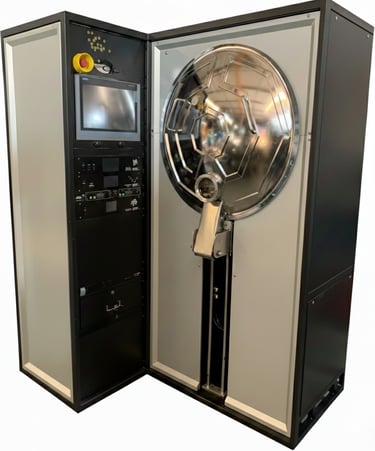
Both methods move atoms from a source onto your substrate in a vacuum chamber:
Load substrate into vacuum (10^-6 to 10^-8 Torr)
Introduce gas or apply energy to the source
Atoms leave source and condense on substrate
Repeat as needed
The difference: how you get the atoms moving.
SPUTTERING: The Workhorse
How It Works:
Target material bombarded with high-energy argon ions
Collision cascades knock atoms from target
Atoms fly across vacuum to substrate
Film builds up atom by atom
Why Sputtering Wins:
✅ Uniform coverage (edges and corners coat evenly)
✅ Better adhesion (momentum means films stick harder)
✅ Alloy films (multiple targets for composites)
✅ Higher packing density (denser, purer films)
✅ Wide material range (works with nearly any metal/compound)
You Control:
Power to target (watts)
Argon gas pressure
Substrate temperature
Target-to-substrate distance
Magnetic field (magnetron sputtering)
Substrate Size: 2" to 30" wide
Best For:
Semiconductor fabs (production wafer coating)
Integrated circuits
Optical coatings (mirrors, AR coatings)
Hard coatings (TiN, CrN)
Magnetic media
Photovoltaics
EVAPORATION: The Precise Alternative
How It Works:
Source material heated to melt/boil point (furnace, electron beam, or resistance heater)
Atoms evaporate from source
Travel in straight lines to substrate
Condense on substrate
Why Evaporation Wins:
✅ Line-of-sight deposition (you know exactly which surfaces get coated)
✅ High deposition rates (very fast thin-film growth)
✅ Low temperature (substrate doesn't need heating)
✅ High purity films (very clean)
✅ Multi-source complexity (co-evaporate for complex films)
You Control:
Source temperature
Evaporation rate (quartz crystal monitor)
Substrate temperature
Substrate geometry/rotation
Background gas pressure
Substrate Size: Research-scale to 12" diameter
Best For:
Research & development
Optical interference coatings
Thermal barriers
Complex multi-layer stacks
Universities and small fabs
Custom materials
Head-to-Head Comparison
FeatureSputteringEvaporationDeposition Rate0.1-1 µm/min1-10 µm/minFilm UniformityExcellentGood (line-of-sight)Film DensityVery HighHighAdhesionExcellentGoodSubstrate HeatingYes, can be highLowAlloy/Compound FilmsEasy (multi-target)Complex (multi-source)Capital Cost$80K-250K+$60K-200KOperating CostLow (Ar gas)Very Low (just power)ComplexityModerateHigh (for complex recipes)Best ForProduction, VolumeR&D, Custom
Which Should You Use?
1. What's your substrate size?
Under 6": Either works
6-12": Sputtering preferred
Over 12": Sputtering (evaporation doesn't scale)
2. What material are you depositing?
Metals (Al, Cu, Ti): Both; sputtering preferred
Alloys (TiW, CrN): Sputtering only
Oxides/Nitrides: Sputtering (reactive)
Organics/sensitive: Evaporation (lower temp)
3. High volume or flexibility?
Production volume: Sputtering
Custom/low volume: Evaporation
4. Budget?
Capital-limited: Evaporation
Volume-driven: Sputtering
5. Need line-of-sight control?
Yes: Evaporation
No: Sputtering
Real Example 1: RF Filters for 5G
Need: Precise multi-layer thickness, 3" substrates, 10,000 units/year
Recommendation: Sputtering
Why?
Reactive sputtering deposits oxides/nitrides
Excellent uniformity across 3"
Consistent recipes batch-to-batch
Better cost-per-unit at volume
$120K system justified by 10K units/year
Real Example 2: University Research Lab
Need: Custom film compositions, small substrates, flexible recipes, tight budget
Recommendation: Evaporation
Why?
Lower capital cost ($80K vs $150K)
Fast material changeover
Precise composition control
Lower operating cost (no gas)
Easier troubleshooting
Hybrid Approach:
Many advanced labs use both.
Example: Hard drive head manufacturing
Evaporation: Precise base layers
Sputtering: Magnetic stack (requires multiple sources)
Evaporation: Protective overcoat
Each tool does what it does best.
Reach out for support or inquiries anytime.
Contact
hours
sales@sputteringneeds.com
1-510-252-9900
Veteran owned and operated
© 2026. All rights reserved.
Monday - Friday
7:00am - 3:00 pm
